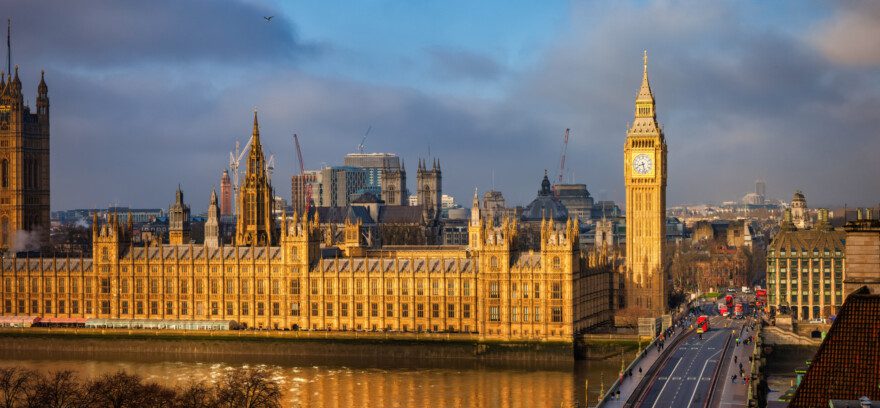
UK markets declined this week, with the FTSE 100 Index falling 2.25% to trade at 9,285 points at the time of writing. The UK economy expanded by 0.1% in August, in line with expectations but underscoring how high borrowing costs and recent tax increases are weighing on activity as Chancellor, Rachel Reeves, prepares for a challenging November Budget.
According to the Office for National Statistics, monthly GDP growth matched the consensus forecast from economists polled by Reuters and followed a 0.1% contraction in July, revised from a previous estimate of flat output. In the three months to August, GDP rose 0.3% compared with the previous three-month period, the same pace as in the second quarter but sharply below the 0.7% recorded in the first quarter, when activity was boosted by pre-emptive spending ahead of US President Donald Trump’s tariffs.
Since then, businesses have faced a more difficult environment, with higher corporate taxes, a rising minimum wage, and trade uncertainty all dampening confidence. Expectations of further tax rises in November are weighing on corporate investment and consumer spending, while a softening labour market poses additional risks to growth.
The Institute for Fiscal Studies estimates that Rachel Reeves must address a £22 billion gap in the UK’s public finances in her upcoming Budget, increasing pressure on the chancellor to raise income tax or cut spending. Without corrective measures, the Institute for Fiscal Studies projects borrowing in 2029-2030 could be around £22 billion higher than forecast by the Office for Budget Responsibility in March. Labour market data from the Office for National Statistics showed modest signs of stabilisation after a year of retrenchment.
Payroll employment rose by 10,000 between July and August, though provisional September figures indicated a similar fall. Revised data showed total employment fell by 90,000 since last year’s tax-raising Budget, less severe than previously thought. The unemployment rate rose to 4.8% in the three months to August, driven by job losses among younger workers.
Meanwhile, the International Monetary Fund warned that inflationary pressures remain elevated, predicting the UK will experience the highest inflation among G7 economies over the next two years, with consumer price inflation expected to average 3.4% in 2025 and 2.5% in 2026. The International Monetary Fund upgraded its 2025 GDP forecast to 1.3% and expects four rate cuts next year, bringing interest rates to around 3%, though it cautioned that the Bank of England is unlikely to ease policy significantly before 2026.
Commodity markets
In the commodity markets, Brent crude futures traded around $60 per barrel on Friday and are set for a weekly fall, on US-China trade tensions and after the International Energy Agency warned of a big surplus next year as OPEC+ producers and rivals lift output amid weak demand.
President Donald Trump said on Wednesday that India would halt oil purchases from its top supplier Russia, and the US would next try to get China to do the same as Washington intensifies efforts to cut off Moscow’s energy revenues and pressure it to negotiate a peace deal in Ukraine. India and China are the two top buyers of Russian seaborne crude exports, which are sanctioned by the US and European Union.
President Trump and Russian President, Vladimir Putin, agreed on Thursday to meet in Hungary to discuss ending the war in Ukraine, a surprise move that came as Moscow feared fresh US military support for Kyiv. The development came as Ukrainian President, Volodymyr Zelensky, headed to the White House on Friday to push for more military support, including US made long-range Tomahawk missiles.
Gold prices traded around $4,240 an ounce on Friday, extending to fresh highs, as signs of weakness in US regional banks, global trade frictions and expectations of more rate cuts sent investors flocking to the safe-haven metal.
Equity markets
US equity futures fell on Friday as concerns over bad loans at regional banks pressured sentiment. In Thursday’s regular trading session, the Dow Jones Industrial Average fell 0.65%, the S&P 500 lost 0.63%, whilst the Nasdaq Composite declined 0.47%.
Treasury Secretary Scott Bessent warned Beijing this week that its sweeping new export controls on rare earths and critical minerals would force the US and other countries to decouple from China. Beijing’s new regime, unveiled last week, requires non-Chinese companies exporting products containing even small amounts of these minerals to obtain a government licence. The move drew condemnation from the US and others, who argue it will significantly disrupt global supply chains given China’s dominance in the rare earths industry.
President Trump threatened to impose an additional 100% tariff on imports from China and other countermeasures by 1st November. The Chinese export controls, set to take effect in December, are expected to have global repercussions – impacting artificial intelligence systems, high-tech products and everyday consumer goods such as cars, smartphones, and household appliances. China has defended its actions, noting that Washington imposed punitive measures on Chinese companies after US and Chinese negotiators held a fourth round of trade talks in Madrid last month.
Washington has rejected that argument and said Beijing appeared to have been planning the measures for some time. The US and China have rolled over successive tariff deadlines since agreeing a ceasefire in the trade war earlier this year. The current 90-day window expires in mid-November. Federal Reserve Chair Jay Powell has warned that the US labour market is showing further signs of distress, signalling that he could be ready to support another interest rate cut later this month.
Powell said that “the downside risks to employment have risen” adding that even without the new Bureau of Labour Statistics data, delayed because of the federal government shutdown, privately produced measures of the jobs market, as well as internal Federal Reserve research, provided enough grounds to show the jobs market was cooling. Chris Waller, a Federal Reserve governor and leading candidate to replace Jay Powell as chair next year, also gave a clear indication that he would vote for lower rates at the US central bank’s meeting in late October.
The information provided in this communication is not advice or a personal recommendation, and you should not make any investment decisions on the basis of it. If you are unsure of whether an investment is right for you, please seek advice. If you choose to invest, your capital may be at risk and the value of an investment may fall as well as rise in value, so you could get back less than you originally invested.